the beach club: designing the yacht's new social heart
For most of yachting history, the stern was where the work happened. Tenders were stowed there, lines were handled there, crew moved through it constantly — it was infrastructure, not experience. The idea that this same space might become the most important room on the boat is genuinely recent, and tracing how it happened says a lot about where yacht design is heading next.
The shift has real dates attached to it. The 105-metre Lady Moura, delivered by Blohm+Voss in 1990, was among the first to fold down her aft terraces toward the water, turning a hard edge into something closer to a threshold. In 2003, Espen Øino’s 79-metre Princess Mariana introduced a floodable tender garage that doubled as a beach platform — a piece of naval engineering doing double duty as a social space. And on a much smaller scale, designer Frank Neubelt recalls fitting a sauna into the transom of the 34-metre Moonen Xanadu in 1996, at an owner’s request, in what he describes as the beach club’s earliest ancestor. None of these were beach clubs in the way the term is used today. They were the moment the stern stopped being purely functional.
What accelerated the idea from novelty to standard feature was smaller yachts proving it could work at any scale. Wider Yachts’ early hybrid-propulsion builds in the early 2010s pushed serious beach club development down into the sub-50-metre category, a shift designer Frank Laupman has credited with making the feature feel essential rather than exceptional. Once owners on 40-something-metre yachts could have a genuine water-level lounge, the beach club stopped being a megayacht signature and became an expectation across the size range.
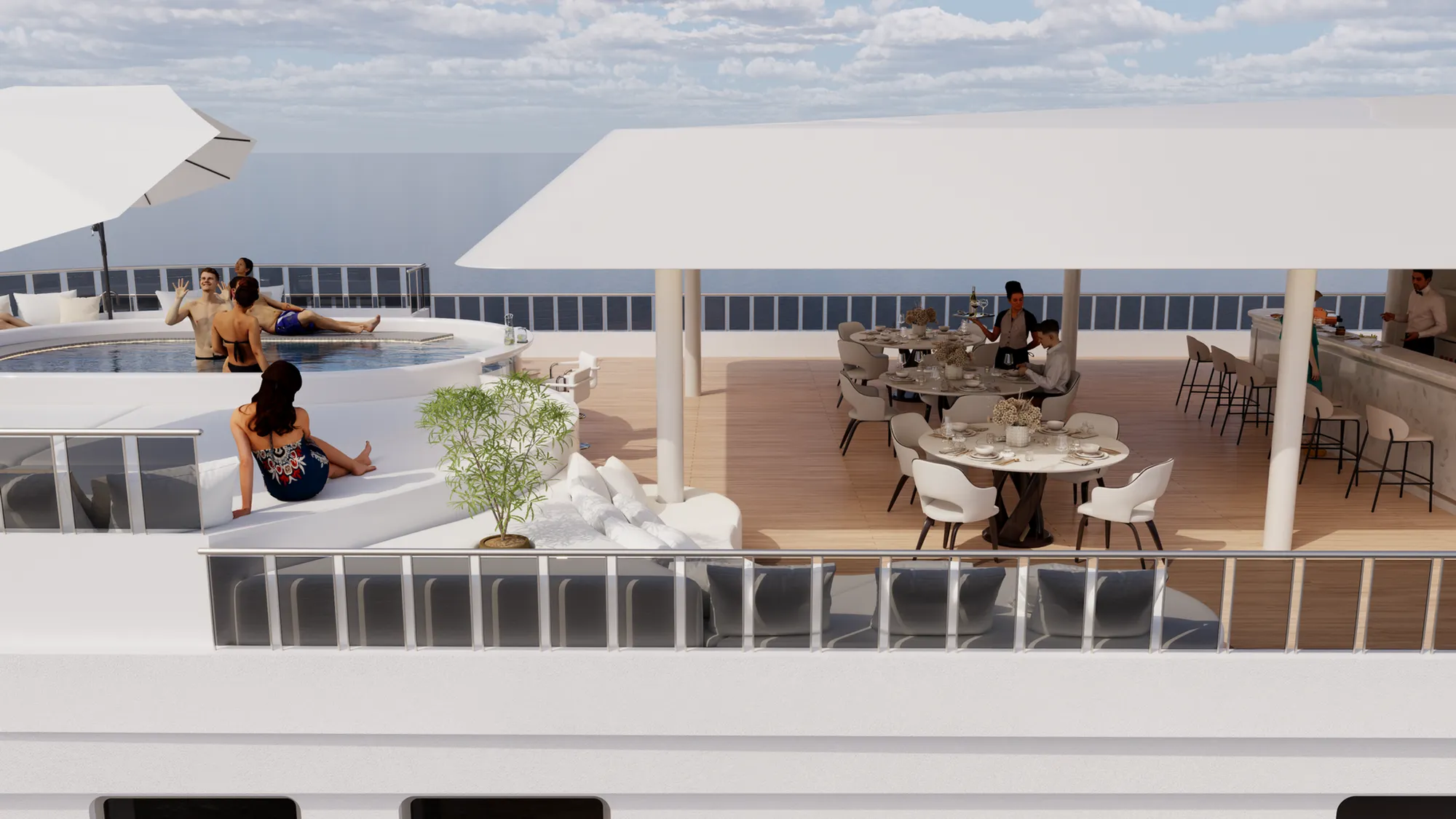
The engineering has caught up with the ambition. Modern platform systems now scale from roughly 2 to 8.2 metres depending on the vessel, deploy from the lazarette in as little as ten minutes, and fold away completely when the yacht is underway — a beach club that exists only when it’s wanted, and disappears the rest of the time. Enclosed sea pools have solved the actual problem with open-water swimming at anchor: current, jellyfish, and the psychological hesitation of jumping into open ocean, all addressed by a net or hull structure most guests never consciously notice. On larger platforms, multi-level beach clubs are now common enough to be their own category — distinct zones for lounging, dining, and water access stacked rather than flattened into one space, the way a well-planned interior separates public and private rooms without walls to announce the difference.
None of this is only an engineering story, though. The same tension that governs interior material choice applies here, arguably more so: everything in a beach club is fully exposed to UV, salt spray, and direct sun in a way even an exterior deck rarely is, so shade and textile choices carry real design weight rather than being an afterthought bolted on after the “real” design work is finished. Shade structures, in particular, have moved from purely functional awnings to considered architectural elements in their own right — a well-designed retractable canopy shapes light and mood the same way a lighting plan does indoors. Decktent’s shade systems, exclusive in the UAE through Yacht IQ, are built specifically for that dual brief: engineered for a marine environment first, designed to look intentional second.
There’s a phrase now circulating in trend reporting that a beach club has become “theatrical” rather than merely functional — lighting that shifts the same space from an afternoon lounge to an evening venue without anyone touching the furniture. It’s a fair description of what’s actually changed. The beach club isn’t an amenity tacked onto the end of the yacht anymore. For a growing number of owners, it’s the room the rest of the vessel is designed around — which means it deserves the same design attention as a salon or an owner’s suite, not the leftover budget after everything else is finished.