dubai maritime city: the gulf’s superyacht hub
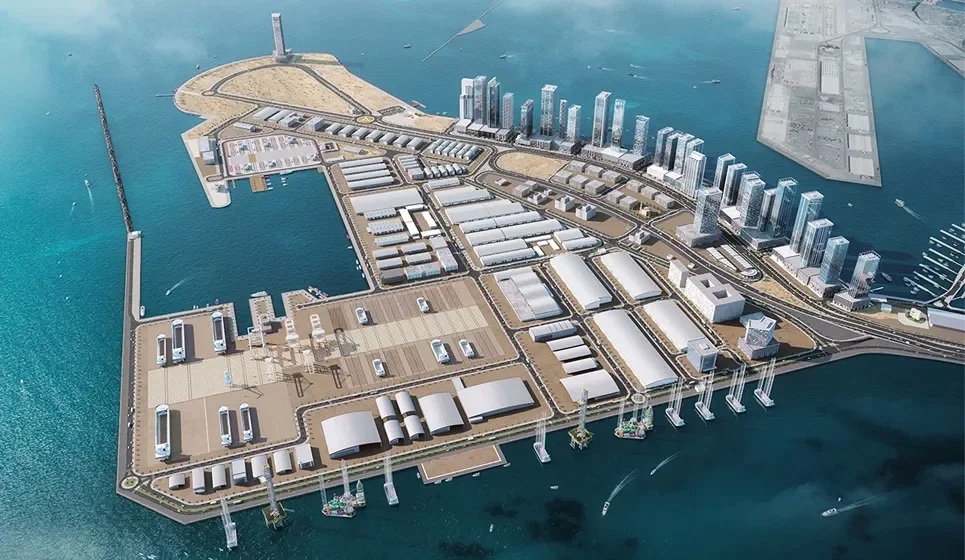
There is a stretch of waterfront between Port Rashid and the open Gulf that, a generation ago, was simply working sea. Today it has a name, a plan, and a gravitational pull. Dubai Maritime City was conceived as a single district where every part of the marine world could sit within reach of every other — shipyards beside design offices, classification surveyors beside chandlers, academies beside the boats they train people to run.
That proximity is the point. For most of the last century, a superyacht owner in this region worked across distances. A refit might be specified in one country, executed in another, and crewed from a third. Dubai Maritime City was built on the opposite logic: that the entire lifecycle of a vessel — design, construction, repair, berthing, brokerage, regulation — gains something when it shares an address.
What has grown there is less a marina than an ecosystem. The hard infrastructure is the visible part: dry docks and lift bays sized for large vessels, deep-water access, fabrication and engineering capacity that can take a yacht out of the water and return it ready for a Mediterranean season. Around that sits the softer infrastructure that owners rarely think about until they need it — surveyors, flag and registration services, marine insurers, paint and coating specialists, the quiet supporting trades that keep a fleet moving.
The community matters as much as the cranes. A maritime district concentrates knowledge. Captains compare notes on summer mooring. Yards share solutions to problems the Gulf creates and the Mediterranean does not. Suppliers learn what the regional fleet actually asks for, rather than what a European catalogue assumes. Over time, this accumulated, local expertise becomes its own asset — the difference between a place that can dock a yacht and a place that understands one.
There is a cultural dimension too, and it is worth naming honestly. Dubai sits at a hinge point between the Mediterranean season and the wider Indian Ocean and Asian cruising grounds.
A vessel wintering here, or staging here between seasons, is not in a backwater. It is in a city that has decided, deliberately, that the sea is part of its future — and has built the institutions to prove it.
None of this happened by accident, and none of it is finished. Dubai Maritime City remains a project as much as a place: a long-term wager that a region better known for its skyline can also be known for its harbours. For the yachting world, the significance is straightforward.
The Gulf now has a centre of gravity — somewhere the fleet can be built, kept, repaired and understood without leaving home water.
For a studio whose work begins and often returns here, that proximity shapes everything. Maison Azure’s interiors are conceived within reach of the yards that build the vessels they will eventually fill — and that closeness, between the drawing and the doing, is one of the quieter advantages of working from this coast.